
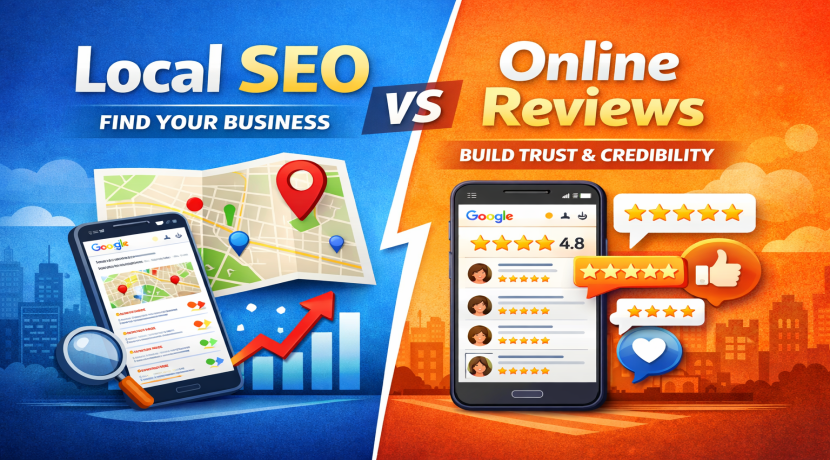
Local SEO vs Online Reviews: What Really Drives Local Business Growth?
2026-Jan-17
In the fast-paced digital landscape of 2026, the distance between a customer’s search and their purchase has shrunk to mere seconds. For small business owners and tech enthusiasts alike, the "near me" search is no longer a luxury—it is the lifeline of commerce. Local SEO is the engine that drives this visibility, but online reviews are the fuel that converts a simple search into a loyal customer. With over 88% of mobile local searches leading to a store visit within 24 hours, the synergy between how you rank and what people say about you has never been more critical. This guide explores how to master these two pillars to ensure your business doesn't just appear on the map but stays at the top of the "Local Pack."
1. The Anatomy of Local SEO in 2026: Beyond the Map
Local SEO has evolved far beyond simply having an address on Google. In 2026, search engines utilize sophisticated AI to determine proximity, prominence, and relevance. While your physical location (proximity) is fixed, your prominence—how well-known and trusted you are—is entirely within your control.
To dominate local search, your Google Business Profile (GBP) must be a living entity. This means:
Hyper-Local Content: Utilizing keywords that mention specific neighborhoods, landmarks, and local events.
NAP Consistency: Ensuring your Name, Address, and Phone number are identical across every directory, from Yelp to Apple Maps.
Entity-Based Search: Search engines now look for "entities"—real-world objects or businesses—meaning your website must link to local organizations, chambers of commerce, and local news outlets to prove its community roots.
For businesses looking to automate and scale this reputation, tools like RatingGrow provide the infrastructure to bridge the gap between local visibility and customer trust.
2. Why Online Reviews are the New "Ranking Currency"
If Local SEO gets you to the door, online reviews invite the customer inside. According to recent 2026 industry data, Review Signals now account for approximately 20% of the ranking weight in Google’s Local Pack. Search engines aren't just looking at your star rating; they are analyzing:
Review Velocity: How often are you getting new reviews? A burst of 50 reviews followed by months of silence is a red flag to AI algorithms.
Keyword Richness: When customers mention specific services (e.g., "The best vegan pizza in downtown Chicago"), Google parses that text to understand exactly what you offer.
Review Diversity: Having 500 reviews on Google but zero on Facebook or industry-specific sites can look inorganic.
3. The Power of the Response: Turning Feedback into SEO Gold
Many business owners view reviews as a one-way street, but the real SEO magic happens in the response. Google has explicitly stated that responding to reviews improves your local visibility.
When you respond, you achieve three things:
1. Trust Building: 89% of consumers are "highly likely" to use a business that responds to all its online reviews.
2. Keyword Integration: You can naturally include local keywords in your replies. (e.g., "Thanks for visiting our [City Name] branch for your [Service Name]!")
3. Conflict Resolution: Handling a 1-star review professionally can often convince the customer to delete it or upgrade their rating, protecting your hard-earned SEO authority.
4. Strategies to Automate Your Review Growth
Asking for reviews manually is a recipe for inconsistency. In 2026, the most successful small businesses use automation to ensure every happy customer is prompted at the peak of their satisfaction.
Integrating a dedicated platform allows you to:
Send automated SMS or Email review requests post-purchase.
Monitor all platforms from a single dashboard.
Showcase your best reviews as "Social Proof" widgets on your website to boost conversion rates.
Ready to put your reputation on autopilot? You can start your free trial with RatingGrow today and see how effortless review management can transform your local rankings.
FAQ: Frequently Asked Questions
Q: Does responding to negative reviews help my SEO?
A: Yes! While the negative review itself might feel like a setback, a professional and timely response signals to search engines that your business is active, managed, and cares about user experience—all of which are positive ranking signals.
Q: How many reviews do I need to rank in the Top 3 "Map Pack"?
A: There is no "magic number," as it depends on your competition. However, in 2026, recency often outweighs volume. Ten reviews from the last month are generally more powerful than 100 reviews from three years ago.